

ProductsPilot AI Review 2026: Is It Worth Trying?
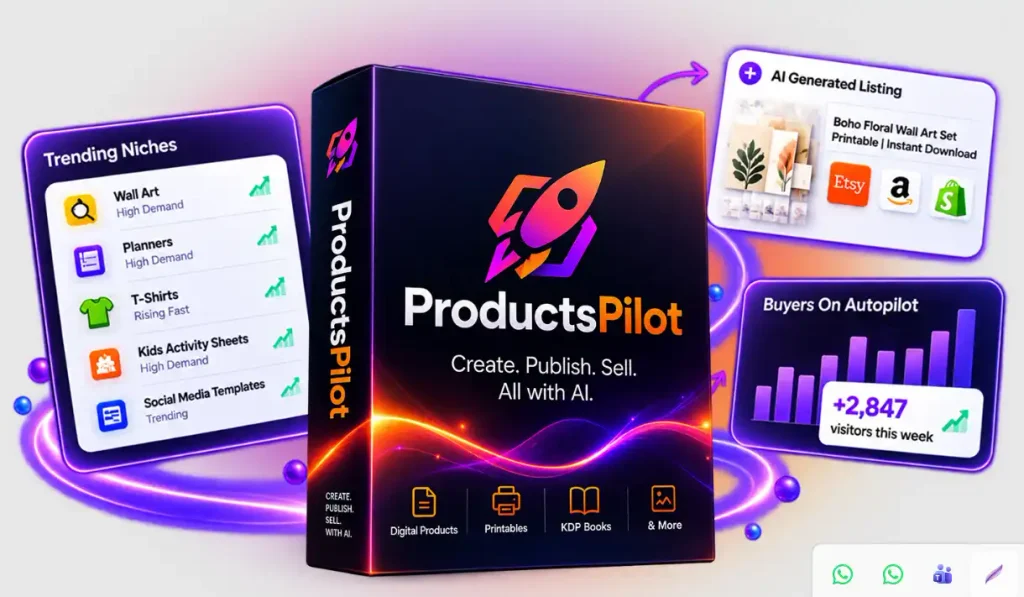
Creating digital products sounds simple until you sit down to do the work. You need product ideas, attractive designs, useful content, and a way to reach people who might actually buy what you create. If you sell printables, publish low-content books, design templates, or run an online business, these tasks can quickly become overwhelming.
In this ProductsPilot AI Review, we’ll explore the tool’s key features, potential benefits, pricing, and limitations to help you decide whether it suits your digital product business.
That is where AI-powered business tools may help. They promise to simplify parts of the creative process, reduce repetitive work, and help entrepreneurs explore new opportunities without building everything from scratch.
In this ProductsPilot AI Review, we will examine what the product may offer, who it could benefit, what limitations you should consider, and how to decide whether it deserves a place in your workflow.
The focus is on practical buying decisions rather than big promises. A tool can sound impressive on a sales page, but its real value depends on the features you receive, the quality of its output, its ease of use, and whether it helps you create products people want.
If you are an Etsy seller, printable creator, Amazon KDP publisher, or digital product entrepreneur, this review will help you identify the questions worth answering before you invest your money.
ProductsPilot AI Review: Quick Product Overview
Before exploring the details, here is a quick overview of ProductsPilot and the information buyers should evaluate.
| Category | Overview |
|---|---|
| Product Name | ProductsPilot |
| Product Type | AI-powered business and digital product tool |
| Product Category | Digital product creation, online business, and marketing tools |
| Potential Audience | Digital product sellers, printable creators, Etsy sellers, POD sellers, and KDP publishers |
| Main Benefit to Evaluate | Whether it simplifies product research, creation, or related business tasks |
| Ease of Use | Depends on the actual interface, available features, and onboarding |
| Price Range | Check the current official offer for verified pricing |
| Best For | Entrepreneurs who want to streamline digital product workflows |
| Purchase Decision | Compare the included features, usage limits, and commercial rights before buying |
Important note: Product features, pricing, and usage rights can change. This review does not assume that every possible AI, SEO, publishing, or design feature is included in ProductsPilot. Confirm the current offer details before purchasing.
What Is ProductsPilot?
In this ProductsPilot AI Review, we examine how ProductsPilot is presented in the context of AI-powered online business and digital product creation.. It is relevant to entrepreneurs who want to explore ways to simplify work associated with creating and selling digital products.
To understand its potential value, think about a typical digital product business.
Suppose you want to sell printable planners. Before you make your first sale, you may need to research customer needs, decide what type of planner to create, prepare the design, write the product description, and publish the listing. You may also need to create promotional content to attract visitors.
Each task takes time, and beginners often struggle to decide which one deserves attention first.
A suitable business tool may help organize or simplify some of these activities. AI-assisted workflows can also help users generate starting ideas, develop content drafts, or reduce repetitive work when those capabilities are available.
However, there is an important distinction between a tool that assists with a task and one that completes an entire business process. You should not assume that ProductsPilot automatically handles product creation, market research, publishing, or sales unless those capabilities are explicitly included in its current offer.
The smartest approach is to identify the specific problem you want to solve and then determine whether the tool addresses it.
Who Is ProductsPilot Designed For?
ProductsPilot may be worth investigating if your work involves digital products, online publishing, or small online businesses.
1. Digital Product Sellers
Digital products can include templates, planners, worksheets, invitations, downloadable artwork, and other files customers purchase online.
If you regularly create new products, a tool that reduces repetitive work may help you spend more time improving your catalog and understanding your customers.
The key question is whether ProductsPilot supports the particular tasks you perform most often.
2. Etsy Sellers
Etsy sellers often need more than a good product idea. They must consider customer demand, listing images, product descriptions, pricing, competition, and search visibility.
An AI business tool may help with some of these tasks if it provides the relevant features. However, using AI does not guarantee that a listing will rank highly or generate sales.https://www.etsy.com
Your product quality, customer experience, and understanding of the marketplace still matter.
3. Print-on-Demand Sellers
Print-on-demand businesses sell products such as posters, apparel, mugs, and other items that are produced after an order is placed.
Sellers in this market need appealing designs and a clear understanding of their target audience. A suitable tool may help with parts of the research or creative workflow, depending on its actual capabilities.
Before buying, confirm whether ProductsPilot specifically supports your intended POD workflow rather than assuming that all design and publishing functions are included.
4. Amazon KDP Publishers
Amazon KDP publishers may create planners, journals, activity books, coloring books, and other eligible publications.
These products require careful planning, suitable interiors, attractive covers, and compliance with publishing requirements. AI can assist with parts of the preparation process, but the publisher remains responsible for originality, accuracy, formatting, and quality.
ProductsPilot should be evaluated against the exact publishing tasks you need help with.https://kdp.amazon.com
5. Freelancers and Side Hustlers
People building a side business often have limited time. They may be working another job while trying to develop an additional source of income.
For these users, convenience matters. A tool becomes valuable when it reduces a genuine bottleneck without creating extra work or unexpected costs.
If ProductsPilot fits that role, it may be worth testing. If it adds complexity to an already simple process, a more focused alternative may be better.
ProductsPilot AI Review: Key Features and Benefits
A useful review should look beyond feature names. What matters is how a feature helps you complete a real task.
This ProductsPilot AI Review examines how the tool may help digital product creators research and develop products for their online businesses.
Because the precise current feature set has not been independently verified here, the following sections explain the capabilities to investigate rather than claiming that every one is included.
AI-Powered Product Research
Product research is one of the most important steps in a digital product business.
Imagine you want to create a printable weekly planner. You could start designing immediately, but you would first benefit from understanding what potential buyers need, which planner formats are available, and how competing products are positioned.
A product research feature, if included, may help you organize ideas or identify areas for further investigation.
Still, AI-generated suggestions should be treated as starting points. They are not proof of market demand.
Before investing time in a product, examine relevant marketplace listings, customer feedback, competing offers, and evidence of buyer interest. Look for a clear reason why someone would choose your product instead of an existing alternative.
Digital Product Creation
Creating a useful digital product requires more than generating a file. It must solve a problem, look professional, and be easy for the customer to use.
For example, a printable budget planner should have readable text, logical categories, adequate writing space, and a practical layout.
As part of our ProductsPilot AI Review, if ProductsPilot includes relevant creation tools, we recommend evaluating the quality of the finished output.. Check whether you can edit the results, control the layout, export suitable files, and make changes without starting again.
A quick first draft can save time, but poor formatting or generic content can erase that advantage.
Workflow Efficiency
Efficiency is one of the main reasons entrepreneurs explore AI tools.
A useful workflow should make a task easier to complete, not simply move the work to a different screen.
When testing ProductsPilot, choose one task you already know how to perform. Record approximately how long it takes using your existing method, then compare that with the time required using the tool.
Also consider how much editing is necessary. A result that takes two minutes to generate but another thirty minutes to correct may not be a meaningful improvement.
This simple test provides more useful information than relying on a broad claim about saving time.
SEO and Marketing Support
Visibility is a major challenge for new online businesses. A good product can struggle to attract buyers if its listing or website does not clearly communicate its value.
If ProductsPilot offers SEO or marketing assistance, examine whether it helps you produce relevant product descriptions, organize keyword ideas, or prepare promotional material.
Remember that keyword suggestions are not the same as verified search demand. Similarly, an AI-written description does not guarantee Google rankings, marketplace visibility, or conversions.
For the best results, combine any automated assistance with keyword research, audience knowledge, accurate product information, and original content.
Ease of Use
A tool may offer many capabilities and still be difficult to use.
When exploring ProductsPilot, pay attention to the sign-up process, dashboard layout, instructions, editing options, and availability of help. Look for clear steps that guide you from the initial task to the finished result.
Beginners should be especially careful about tools that require a long learning period before delivering useful results.
If a trial or demonstration is available, use it to complete one small project. That will reveal more about the learning curve than a long list of advertised features.
Output Quality and Customization
The final result matters more than the number of options displayed on a dashboard.
For digital product sellers, output quality may include visual consistency, correct text, appropriate file formats, editable layouts, and suitability for the intended platform.
Customization is equally important. You should be able to make meaningful changes rather than accepting a generic result that looks similar to hundreds of competing products.
Always inspect the final output before publishing or selling it.
Real-Life Usage Experience: What Could Using ProductsPilot Look Like?
To understand the potential value of ProductsPilot, consider a realistic example.
Imagine you are starting an Etsy shop focused on printable planners. You have limited design experience and do not want to spend several hours creating your first product before you know whether customers are interested in it.
A workflow built around ProductsPilot’s advertised capabilities could look like this.
Step 1: Choose a Product Niche
You begin with a topic such as budgeting, meal planning, or daily organization.
ProductsPilot advertises an AI niche research feature that evaluates demand and competition. This could help you narrow your choices before creating a product.
However, demand scores should not replace your own research. Check competing listings, customer reviews, pricing, and the specific problems buyers want to solve.
Step 2: Choose a Design Direction
The advertised creation workflow lets users choose a visual style or consider AI-generated style suggestions.
For example, a budget planner might use a clean layout with clear headings, simple tables, and enough space for monthly expenses.
This approach may be useful for beginners who struggle to start with a blank page. You should still review the design for readability, originality, and practical use.
Step 3: Generate and Review the Product
ProductsPilot advertises automated product-set creation, printable files, mockups, and listing materials.
These features could reduce the number of separate tasks involved in preparing a product for sale.
Before publishing, inspect the files carefully. Check spelling, page dimensions, image quality, consistency, and whether the product matches the description. Never assume that an automatically generated product is ready to sell without review.
Step 4: Prepare the Listing
A product listing needs a clear title, an accurate description, relevant search terms, and useful images.
ProductsPilot advertises listing support for Etsy and Gumroad. If these features work as described, they may reduce some of the repetitive work involved in preparing listings.
You should still verify all listing details and confirm which publishing steps are automated versus which require your approval.
Step 5: Promote the Product
Publishing a listing is only the beginning. Customers must discover it before they can buy it.
ProductsPilot advertises a Traffic Builder covering multiple promotional channels. Before relying on this feature, check which channels are supported in your account, how publishing works, and whether any additional setup is necessary.
Traffic tools can help distribute content, but they cannot guarantee visitors, sales, or profit.
My assessment: The advertised workflow is appealing because it connects several tasks that sellers often handle separately. The important test is whether the complete process produces useful, original products and saves enough time to justify the cost. I have not independently tested the software, so the workflow above describes its advertised capabilities rather than verified personal experience.
ProductsPilot Pros and Cons
Every tool has trade-offs. Here are the main advantages and limitations to consider before buying ProductsPilot.
Pros
- AI-assisted niche research: Its advertised research feature may help beginners explore product ideas and evaluate demand and competition.
- Multiple product categories: The offer describes support for products such as wall art, planners, templates, invitations, educational resources, craft files, and other digital downloads.
- Streamlined creation workflow: Automated product generation, mockups, and listing materials could reduce repetitive preparation work.
- Beginner-friendly approach: Choosing from suggested ideas and styles may be easier than starting every project from scratch.
- Commercial usage rights advertised: The sales offer states that commercial rights are included for products created with the software. Read the current licence terms before relying on this.
- Browser-based access: The advertised software runs in a browser, avoiding the need to install a traditional desktop application.
- Marketing assistance: Its advertised Traffic Builder may help users prepare and distribute promotional content across supported channels.
Cons
- Cons identified in this ProductsPilot AI Review include: AI-generated content can contain design problems, mistakes, or generic elements that need editing.
- No guaranteed income: Finding a promising niche or producing more listings does not guarantee customers or sales.
- Monthly product limits: The advertised Premium offer specifies 15 complete products per month, which may be restrictive for high-volume sellers.
- Learning is still required: Users must understand their audience, product quality, pricing, marketplace rules, and customer needs.
- Additional offers may cost more: Optional upgrades are advertised separately. Review the checkout carefully so you understand the total cost.
- Feature claims need practical testing: Marketing descriptions do not establish how well every feature performs in real-world conditions.
- Marketplace competition remains: Other sellers may offer similar products, so originality and positioning still matter.
The main trade-off is straightforward: ProductsPilot aims to simplify production, but you remain responsible for quality, compliance, and the decisions that make a product worth buying.
Who Should Buy ProductsPilot?
Based on our ProductsPilot AI Review, this tool may be worth considering if you fit one of the following profiles.
Beginners Building Their First Digital Product Business
If you have ideas but lack confidence in design or product preparation, an AI-assisted workflow could help you move from planning to creating a first draft.
Start small. Create one product, inspect the results, and decide whether the workflow is genuinely useful before building a large catalog.
Etsy and Digital Download Sellers
Existing sellers may benefit from a faster way to explore new product categories or prepare additional listings.
For example, someone who already sells printable planners might experiment with complementary worksheets or budgeting templates. New products should serve a clear customer need rather than simply increase the number of listings.
Amazon KDP Publishers
The advertised product categories include low-content publishing materials. This may interest people creating journals, coloring books, puzzle books, or similar publications.
However, verify which KDP-ready files and features are included in your selected plan. Review Amazon’s current content, quality, and publishing requirements before uploading AI-assisted work.
Freelancers and Side Hustlers
People working with limited time may appreciate a workflow that reduces repetitive creative tasks.
ProductsPilot may be useful if the time saved is greater than the time needed for reviewing and editing its output. A short practical test is the best way to determine this.
Entrepreneurs Exploring Multiple Product Types
If you want to test different digital product categories without learning a completely separate workflow for each one, the advertised range of product types may be attractive.
Just remember that creating different products does not automatically mean you understand the audiences who buy them. Research and customer feedback remain essential.
Who Should Avoid ProductsPilot?
ProductsPilot will not be the right choice for everyone.
You may want to avoid it if:
- You already have an efficient design process and do not need AI-assisted creation.
- You require complete creative control over every design element and prefer working in specialized design software.
- You expect guaranteed passive income without product research, quality checks, or promotion.
- You need a specific feature that the current plan does not include.
- You are uncomfortable with AI-generated designs or have strict originality requirements.
- You cannot comfortably afford the purchase or any additional costs.
- You prefer to create a small number of highly customized products rather than use a standardized production workflow.
It is also worth considering a free or low-cost alternative if your main need is simply to design one planner or write a few product descriptions.
The best tool is the one that solves your actual problem, not necessarily the one with the longest feature list.
ProductsPilot vs. Alternative Tools
ProductsPilot belongs to a different category from a traditional design editor. Its advertised approach combines research, product creation, listing preparation, and marketing assistance. Alternatives may focus on only one part of that process.
Here is how the approaches compare.
| Factor | ProductsPilot | Canva | Manual Workflow |
|---|---|---|---|
| Main purpose | Integrated digital product workflow | Visual design and content creation | Full control over each task |
| Product research | Advertised AI niche research | Separate research generally needed | Research performed manually or with separate tools |
| Design approach | AI-assisted product generation | Templates and visual editing | Depends on your chosen software and skills |
| Listing preparation | Advertised listing assistance | Listings usually prepared separately | Written and prepared manually |
| Marketing | Advertised multi-channel traffic features | Design assets for promotional content | Separate marketing process |
| Creative control | Depends on available editing options | Extensive visual editing | Potentially very high |
| Learning curve | Must be tested in practice | Varies with the task | Depends on the tools and experience |
| Best suited for | Users wanting a connected workflow | Users prioritizing visual design | Users wanting flexibility and control |
ProductsPilot vs. Canva
Alternative: Canva https://www.canva.com
Canva is a strong option for people who want to create and edit designs using templates and visual tools. It may suit sellers who already understand their target audience and need more control over layouts, branding, and presentation.
ProductsPilot’s advertised advantage is its broader workflow, including niche research and listing-related assistance. If you want help with several stages of digital product preparation, that integrated approach may be more convenient.
On the other hand, if design flexibility is your main priority, Canva may be a better fit. The two tools serve overlapping but different needs, and you should compare their current features and total costs before deciding.
ProductsPilot vs. Creating Products Manually
Manual creation gives you direct control over research, design, writing, and publishing. It can be a good choice if you have established processes or create specialized products that require careful customization.
ProductsPilot may appeal to people who want to reduce the number of separate tasks involved. However, you should compare the quality of the final product, not just how quickly the first draft appears.
For some businesses, a combination of AI assistance and manual editing will deliver the best balance.
Which should you choose? Consider ProductsPilot if workflow integration is your main priority. Choose a design-focused tool if visual control matters most, or a manual process if you need a highly customized result.
[ADD PRODUCT BUTTON HERE]
ProductsPilot Pricing: What Should You Expect to Pay?
In this section of our ProductsPilot AI Review, we evaluate the pricing structure, which is an important part of any buying decision., especially for beginners who are trying to build a business without spending too much upfront.
The ProductsPilot sales offer I reviewed advertises the following plans and prices. These are promotional figures displayed in the offer, not a guarantee of the price available when you visit the checkout.
| Plan | Advertised Price | Main Consideration |
|---|---|---|
| ProductsPilot Premium | $37 one time | Advertised allowance of 15 complete products per month and access to the core workflow |
| ProductsPilot Bundle | $317 | Advertised package with additional marketing, agency, and growth-related upgrades |
| ProductsPilot Unlimited | $67 per year | Advertised as an upgrade with unlimited product creation, a premium image engine, bulk creation, and API access |
Prices, availability, upgrade terms, and promotional offers may change. Confirm the current checkout details and renewal terms before purchasing.
Is the $37 Premium Offer Worth It?
The advertised Premium offer may be the most sensible starting point for a beginner who wants to test the core product workflow without committing to a more expensive bundle.
Before buying, ask yourself three questions:
- Will I use the product categories and features included in this plan?
- Does the monthly product allowance fit my actual needs?
- Can I create products that are useful enough to justify the expense?
If you only want to create one or two products using a familiar design tool, a separate purchase may not be necessary.
If you plan to build a digital product catalog and value the advertised research, creation, and listing workflow, testing the core plan may make more sense.
Should You Buy the Bundle?
The larger bundle may appeal to users who need the additional features listed in the current offer. However, a bigger package is not automatically better value.
Do not pay for agency tools, advanced marketing features, or higher production limits unless you have a realistic plan to use them.
For a beginner, starting with the core offer and upgrading only when a genuine need arises is often the more cautious approach.
Buying Guide: What to Check Before Purchasing ProductsPilot
Before making a decision, work through this checklist.Confirm the current price and whether the payment is one-time or recurring.Check exactly which product categories are included in your plan.Verify monthly product limits and any restrictions on exports or publishing.Read the commercial licence and confirm your rights to sell generated products.Check which marketplaces and traffic channels are actually supported.Review the refund policy, deadline, and procedure.Look for optional upgrades and additional costs at checkout.Make sure the tool addresses a real problem in your current workflow.
0 of 8 checks completed
Mistakes to Avoid
1. Expecting instant income
A tool can help you prepare products, but it cannot guarantee that buyers will find or purchase them. Treat revenue claims in promotional material cautiously and plan your budget around the possibility of earning nothing initially.
2. Publishing every generated product without checking it
Typos, inconsistent layouts, weak designs, and incorrect file dimensions can harm customer trust. Inspect every product before selling it.
3. Ignoring intellectual property
Make sure your designs do not misuse copyrighted material, protected characters, trademarks, or other people’s work. Review the applicable platform policies and licence terms, including the terms governing AI-generated content.
4. Confusing more listings with more sales
A large catalog is not automatically a successful business. A small collection of useful, well-presented products can be a better starting point than dozens of poorly researched listings.
5. Buying every upgrade immediately
Start by identifying the capabilities you actually need. Compare the cost of an upgrade with the value it could realistically provide.
Is ProductsPilot Worth Buying?
The answer depends on what you need and how you intend to use it.
ProductsPilot’s advertised combination of niche research, AI-assisted product creation, listing preparation, and traffic tools is appealing because these activities often require separate processes.
For a beginner, connecting those steps could make it easier to move from an idea to a product listing. For an established seller, the potential value depends on whether it improves an existing workflow without sacrificing quality or creative control.
However, there are important limits to keep in mind.
The software cannot guarantee demand, rankings, customer traffic, or sales. Its generated products still need human review, and its real value depends on the quality of the results you can produce with it. I have not independently benchmarked the software or verified its advertised performance claims.
Before buying, confirm the features included in your plan, test a sample workflow if possible, and make sure the cost fits your budget.
If you are considering ProductsPilot primarily because you want a simpler way to create and prepare digital products, the core offer may be worth evaluating. If you already have a workflow that works well, you may be better off keeping your current tools.
Frequently Asked Questions About ProductsPilot AI
1. What is covered in this ProductsPilot AI Review?
In this ProductsPilot AI Review, ProductsPilot is examined as an AI-powered digital product business tool designed to simplify online creation. Its advertised features include niche research, product creation, mockups, listing preparation, and marketing assistance, depending on your selected plan.
2. Is ProductsPilot suitable for beginners?
It may suit beginners who want help with parts of the digital product creation process. However, new users still need to learn about product quality, customer needs, marketplace rules, and promotion.
3. How much does ProductsPilot cost?
The offer reviewed advertises a Premium plan at $37 one time, a Bundle at $317, and an Unlimited upgrade at $67 per year. These prices may change, so confirm the current offer and any recurring charges before purchasing.
4. Can I use ProductsPilot to create products for Etsy?
ProductsPilot advertises digital product creation and Etsy listing support. Check the current plan to confirm which features are included and which steps require manual work. You must also comply with Etsy’s current seller and creativity policies.
5. Can ProductsPilot help with Amazon KDP?
The product’s advertised range includes low-content publishing-related products, but you should confirm whether KDP-ready interiors, covers, and relevant publishing features are included in your selected plan. Always review Amazon KDP’s current publishing requirements.
6. Does ProductsPilot guarantee sales or passive income?
No tool should be treated as a guarantee of sales or passive income. Results depend on product quality, buyer demand, competition, pricing, discoverability, and other factors. You may spend time and money without making a profit.
7. Does ProductsPilot include commercial rights?
The reviewed sales offer states that commercial rights are included for products created using the software. Read the current licence carefully to understand the exact permissions, restrictions, and responsibilities that apply to your work.
8. Is ProductsPilot better than Canva?
They serve different purposes. ProductsPilot advertises a broader digital product workflow, while Canva focuses on visual design and content creation. ProductsPilot may suit users seeking workflow assistance, while Canva may be preferable for users who prioritize hands-on design control.
Final Verdict: Should You Try ProductsPilot in 2026? https://techproductdeals50.com
ProductsPilot is worth investigating if you want to build a digital product business and prefer a more connected approach to researching ideas, preparing products, and creating listings.
Its advertised feature set could be useful for printable creators, Etsy sellers, digital download businesses, and entrepreneurs who want to reduce repetitive work. The potential advantage is convenience: instead of handling every step separately, you may be able to complete more of the workflow in one place.
But convenience alone does not make a successful business.
You still need to understand your customers, choose products with a clear purpose, check every file, follow marketplace rules, and promote your work effectively. No software can remove all of those responsibilities, and there is no guarantee that an investment will generate a return.
My recommendation is to begin with your actual needs. If the core plan includes the features you want, the price is affordable, and you have verified the terms, consider testing it on one small project before making a larger commitment.
If it produces a useful result, saves meaningful time, and fits your workflow, it may deserve a place in your business. If it does not, you can continue with simpler tools and a more manual process.
Ultimately, the best reason to buy ProductsPilot is not the promise of easy money. It is the possibility of making your digital product workflow more manageable while retaining responsibility for the quality and value of what you sell.
Ready to explore the current ProductsPilot offer? Review the included features, pricing, and terms carefully before deciding whether it fits your business goals.
Our ProductsPilot AI Review highlights the features, potential advantages, and limitations you should consider before making a purchase decision.